Showing posts with label history. Show all posts

11 May 2014

A Man in Full

Wolf Hall
By Hilary Mantel

At the front of Wolf Hall is a list of characters. There are fifty of them. By the time I’d finished the book, every one, even the most minor, had a distinct face and personality. Although the action is narrated exclusively from the principal character’s point of view and we are always privy to his thoughts, we are nonetheless enabled to form our own opinions of all the characters. These may not always agree with Cromwell's view of them — or even, perhaps, the author’s. 

That is literary mastery of a very high order.

Of course, the principal characters in this story are well known to us. Biographies and contemporary portraits of 
Henry VIII of England, Thomas Cromwell, Anne Boleyn, Katherine of Aragorn, Cardinal Wolsey and Sir Thomas More all exist and are familiar to many people, particularly in the UK, from their history schoolbooks. But the virtue of Mantel’s writing is that she disposes of our preconceptions regarding these famous actors on history’s stage and turns them into real, complex, conflicted people.

The story rattles along at breakneck speed. Though it is all history (there are times when Mantel even tells you what letters Cromwell wrote, and to whom, on a particular night, and you can bet your life those letters really were written, and still exist somewhere), she manages to create tension, suspense and instants of surprise and revelation despite the reader’s foreknowledge of the course of events (though it is probably not advisable to look up the history of the period in too much detail while reading the book).

Period and place are brought to life in loving, often gritty detail. As for the historical and political context, I don't think any author could have managed it better. Frankly, I don't see how I can praise this book highly enough.


29 March 2013

Robes and Cudgels

I wonder if the people currently attacking churches and mosques in Sri Lanka have ever considered the damage they are doing to their own faith—Buddhism.

Christianity and Islam are strong world religions. Some buildings and valuables will be lost in these attacks, there may even be some martyrs, but persecution in Sri Lanka will only make them stronger. No Christian or Muslim is going to abandon his belief or practice because of these attacks.

In contrast, Buddhism itself will take generations to recover from the damage inflicted on it by these extremists. It may never recover at all.

Buddhism gets a good press, by and large, in the non-Buddhist world. In the twentieth century, it enjoyed perhaps the most felicitous reputation of all world religions. Buddhists were thought to be peaceful, kindly, reasonable people: a little unworldly perhaps, as befits those who practise detachment as a spiritual discipline, but certainly none the worse for that.

Many non-Buddhists—some religious, others not—have found great wisdom in the teachings of the Buddha, as well as practical instruction on how to live calmer, less stressful, more peaceable lives. I am one of these people, and although I will never be a practising Buddhist, I have a great deal of affection, sympathy and respect for the religion. There are millions like me around the world.

Sri Lanka’s latest gift to world Buddhism—the image of a robed monk at the head of a violent, thuggish mob—is going to change all that. Indeed, it has already begun to do so. The world media are carrying such images, and the story of crimes committed in Sri Lanka in the name of Buddhism, into hundreds of millions of homes around the world. Buddhism has lost its innocence. It will now be obliged to face the same charge of crimes against humanity that Christianity, Islam and Judaism have faced for centuries. It will be judged, like those faiths, and like them it will be found wanting. Its hitherto unstained reputation will be sullied and tattered.

I have heard many concerned Sri Lankan Buddhists disavow any fellowship with the extremists, insisting that the latter are not true Buddhists. They may well be right, but this defence won’t stand up in the court of history. Faiths—like political institutions, like social movements, above all like people—are correctly judged by their actions, not by their words. As far as any non-Buddhist is concerned, these people are what they profess to be: Buddhists. What they do, they do in the name of Buddhism. This will never be forgotten by the world. These people are making history, and it is their faith which will bear the stigma of it for all time to come.

There is only one escape from this judgement and the opprobrium that will follow from it. Sri Lankan Buddhists, both as individuals and as members of various Buddhist social groups and communities, must publicly and unequivocally condemn the acts of the extremists, repudiating them as unBuddhist.  They must demand that the persons bringing Buddhism into such disrepute be spurned by the Buddhist community, and any who commit violent and criminal acts in the name of Buddhism should be brought to justice and punished. Above all, they must state clearly and publicly that as Buddhists, they recognise the right of non-Buddhists to their own religious faith and practice. And they should apologise, unreservedly, for the wrong that has been done in the Buddha’s name.

Only if these things are done can Buddhism ever hope to recover from the damage presently being done to it in Sri Lanka, by people who claim to be Buddhists and to speak for Buddhism.

06 March 2012

Man of the World

The Travels of Ibn Battutah
Edited by Tim Mackintosh-Smith

Most Ceylonese have heard of Ibn Battutah, a Moroccan Arab traveller of the fourteenth century who visited our island around the year 1344 and climbed Adam’s Peak under the protection of the Tamil ruler of Puttalam. Ibn Battutah made Marco Polo look like a stay-at home; he not only visited China and East Asia, as Marco did, but also took in the Levant, India, the Maldives, Indonesia, the Sahara, Mali and the Niger basin, the coast of East Africa and Arab-occupied Spain. Unlike Marco, he tended to travel first-class – more often than not as an honoured guest and counsellor to the various rulers, mostly Muslim, he met along the way.

Ibn Battutah had this advantage over Marco Polo: the world he travelled was a largely Muslim one, and he was more or less at home in it. Even on the few occasions when he went beyond the borders of Dar-ul-Islam (such as his visit to Serendib), it was to places where Muslim power was recognized, Muslims were treated with respect, and a speaker of Arabic or Farsi could nearly always be found to act as translator. As a specialist in Islamic jurisprudence, his abilities were everywhere in demand, and he was often given positions of high authority (as Marco also was, in China). Indeed, he often had trouble detaching himself from the retinues of the various sultans and amirs who befriended him.

He was not, by our standards, a nice man. A sexual hypocrite who condemned the ‘debaucheries’ of others but himself travelled with sex slaves whom he acquired and dispensed with at will, he also frequently contracted marriages with women whom he would ruthlessly divorce when it was time to move on. He was a staunch Islamic conservative who delighted in applying the strictures of religious sanction to others. He boasts of humiliating a respected Jewish doctor at the court of a minor Turkish potentate, calling the man a ‘god-damned son of a god-damned father’, and speaks of trying (without success) to force the women of the Maldives to cover up their bosoms; he observes disapprovingly that when he ordered the hand of a thief in that country to be cut off, ‘many of those present fainted.’ There is also a faint odour of cowardice arising from the text from time to time, particular with regard to sea voyages and shipwrecks, though our narrator always conducts himself worthily in the end.

In other words, he was a man of his time, that time being the late Islamic Middle Ages. This mediaeval world had little of the crudity, filth and squalor of contemporary Europe. The light and intelligence of a refined, world-spanning high civilization – Islamic civilization – illuminated daily life in places as far apart as Granada and Sumatra, and Ibn Battutah himself is one of its brightest flowers. Though not ill-read in these matters, I was repeatedly surprised by how ‘modern’ and civilized were the ways of this great, pan-Islamic culture – more so than its European contemporaries and most of the ‘infidel’ cultures the narrator encounters in Asia and Africa. Only China presents Ibn Battutah with a cultural challenge beyond his ability to surmount, and he recoils from it as from an alien environment in which life is not long sustainable.

Of course, not everything is enlightened and refined in Ibn Battutah’s world. He tells of much cruelty, to animals as well as people and particularly towards women. At one point he recounts, as a fact worthy of remark but not, apparently, of disapproval, that the punishment meted out to adulterous women among the Arrakanese is that ‘the sultan orders all his household attendants to copulate with her, one after another till she dies, in his presence. Then they throw her into the sea.’ There is also a great deal of superstitious nonsense in his account, and in this regard he shows himself an eagerly credulous witness, especially when it comes to the spurious or fortuitous ‘miracles’ of various shaikhs (Muslim holy men) he encounters on his journeys. Still, modern travellers (especially travellers of the internet) are often as gullible as he in such matters, with far less excuse.

Though certain chapters and specific details of chronology or place are questionable, Ibn Battutah’s account of his journeys appears largely accurate. Most of the places he visited can be identified, even though they no longer have the same names. In this he is again superior to Marco Polo, whose adventures contain a large admixture of fantasy.

Tim Mackintosh-Smith’s redaction, which condenses a very long and much worked-over original, has been widely praised; it is sensitive to nuance and very readable. The end-notes are not copious, but they are informative and add a valuable extra dimension of perspective to the text (although I disagree with his tentative identification of ‘the seat of the principal sultan’ of Serendib; this, at the time, was probably Kurunegala, though Battutah’s description fits Ratnapura better).

Best of all, Mackintosh-Smith lets Ibn Battutah’s attitudes and personality shine through. This is a brilliant book, a modern, readable version of one of the prime sources for the geography of the mediaeval world, and particularly of that great empire of Islam which was even then in decline, but whose greatness was still acknowledged wherever it was known. It is also a wonderful read, and I recommend it highly.

28 February 2011

Cruel Britannia

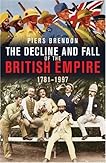
The Decline and Fall of the British Empire, 1781-1997The Decline and Fall of the British Empire, 1781-1997 by Piers Brendon

Being a product of the British Empire, I have something of a soft spot for it. Piers Brendon doesn’t. This massive book, which took me nearly a month to finish, has almost nothing good to say about history’s biggest-ever empire, concentrating instead on land-grabs, exploitation of peoples and resources, imperial arrogance, corruption and perfidy, military and political blunders, atrocities of various kinds, acts of cowardice and betrayal, policies of neglect and policies of divide and rule. There is, admittedly, plenty of such material to choose from. I don't believe Brendon misses any of it.

What he does miss, apart from a handful of grudging references thinly sprinkled across more than 650 closely-printed pages, is the plethora of benefits that British rule brought the colonies. British-built roads, railways, seaports and airfields were designed to facilitate colonial commerce and project imperial power, yet were of incommensurable value to the local people who also used them. British trade and colonial economic development benefited locals too, and not just the comprador classes. British-run schools and missions were designed to create docile and usefully employable imperial subjects, yet also propagated modern knowledge, helped overcome superstition and ignorance and introduced to subject peoples the selfsame liberal and humanitarian ideas that would, in time, encourage them to demand and win their freedom. If a majority of the world’s peoples today can be termed ‘civilized’ in any sense, then it is the British and their empire that deserve the lion’s share of the credit.

Brendon isn’t interested in any of that. He just goes banging on about the horrors of British rule, even when forced to admit that other empires, from that of Rome to Japan’s notorious wartime ‘Asian Co-Prosperity Sphere’, were far worse. A benign empire is, of course, a contradiction in terms; but I do believe the British tried harder than any other imperial power, and with more success, to resolve that contradiction.

It is hard to understand exactly what the author’s motivation was to research and write this book. Clearly he has an axe to grind and it cuts to the left, but this is just a smear job with no larger political conclusions drawn from it. I suppose there is a market for this kind of thing, presumably among leftist malcontents in the West. Many times I was tempted to quit reading and fling the book across the room. I persevered because of my interest in the subject; you might say I persisted for scholarly reasons.

And talking of scholarship, that in the book appears largely second-hand. Original sources are relatively few. The text is copiously annotated (there are nearly 100 pages of endnotes!) but most of the notes are just attributions of clever turns of phrase Brendon has mined from other people’s work; only rarely do they seem to offer factual support for his assertions. On the subject of my own country many of his statements are flatly wrong, leading me to believe that his scholarship regarding other parts of the erstwhile British Empire is probably just as sloppy.

Brendon also seems to have a personal grouse against Rupert Murdoch, and misses no opportunity to slander the man, the newspapers he owns, and even Murdoch's forebears. Astonishing, that he should descend to such pettiness in the midst of this Herculean literary effort.

Incidentally, and ironically, I borrowed this book from the British Council library in the capital city of the former British colony where I was born and still live. I guess it was put there by some of the aforementioned leftist malcontents; but whatever the cause, its presence on those shelves itself gives the lie to many of Brendon's slanders.