The Travels of Ibn Battutah
Edited by Tim Mackintosh-Smith
Most Ceylonese have heard of Ibn Battutah, a Moroccan Arab traveller of the fourteenth century who visited our island around the year 1344 and climbed Adam’s Peak under the protection of the Tamil ruler of Puttalam. Ibn Battutah made Marco Polo look like a stay-at home; he not only visited China and East Asia, as Marco did, but also took in the Levant, India, the Maldives, Indonesia, the Sahara, Mali and the Niger basin, the coast of East Africa and Arab-occupied Spain. Unlike Marco, he tended to travel first-class – more often than not as an honoured guest and counsellor to the various rulers, mostly Muslim, he met along the way.
Ibn Battutah had this advantage over Marco Polo: the world he travelled was a largely Muslim one, and he was more or less at home in it. Even on the few occasions when he went beyond the borders of Dar-ul-Islam (such as his visit to Serendib), it was to places where Muslim power was recognized, Muslims were treated with respect, and a speaker of Arabic or Farsi could nearly always be found to act as translator. As a specialist in Islamic jurisprudence, his abilities were everywhere in demand, and he was often given positions of high authority (as Marco also was, in China). Indeed, he often had trouble detaching himself from the retinues of the various sultans and amirs who befriended him.
He was not, by our standards, a nice man. A sexual hypocrite who condemned the ‘debaucheries’ of others but himself travelled with sex slaves whom he acquired and dispensed with at will, he also frequently contracted marriages with women whom he would ruthlessly divorce when it was time to move on. He was a staunch Islamic conservative who delighted in applying the strictures of religious sanction to others. He boasts of humiliating a respected Jewish doctor at the court of a minor Turkish potentate, calling the man a ‘god-damned son of a god-damned father’, and speaks of trying (without success) to force the women of the Maldives to cover up their bosoms; he observes disapprovingly that when he ordered the hand of a thief in that country to be cut off, ‘many of those present fainted.’ There is also a faint odour of cowardice arising from the text from time to time, particular with regard to sea voyages and shipwrecks, though our narrator always conducts himself worthily in the end.
In other words, he was a man of his time, that time being the late Islamic Middle Ages. This mediaeval world had little of the crudity, filth and squalor of contemporary Europe. The light and intelligence of a refined, world-spanning high civilization – Islamic civilization – illuminated daily life in places as far apart as Granada and Sumatra, and Ibn Battutah himself is one of its brightest flowers. Though not ill-read in these matters, I was repeatedly surprised by how ‘modern’ and civilized were the ways of this great, pan-Islamic culture – more so than its European contemporaries and most of the ‘infidel’ cultures the narrator encounters in Asia and Africa. Only China presents Ibn Battutah with a cultural challenge beyond his ability to surmount, and he recoils from it as from an alien environment in which life is not long sustainable.
Of course, not everything is enlightened and refined in Ibn Battutah’s world. He tells of much cruelty, to animals as well as people and particularly towards women. At one point he recounts, as a fact worthy of remark but not, apparently, of disapproval, that the punishment meted out to adulterous women among the Arrakanese is that ‘the sultan orders all his household attendants to copulate with her, one after another till she dies, in his presence. Then they throw her into the sea.’ There is also a great deal of superstitious nonsense in his account, and in this regard he shows himself an eagerly credulous witness, especially when it comes to the spurious or fortuitous ‘miracles’ of various shaikhs (Muslim holy men) he encounters on his journeys. Still, modern travellers (especially travellers of the internet) are often as gullible as he in such matters, with far less excuse.
Though certain chapters and specific details of chronology or place are questionable, Ibn Battutah’s account of his journeys appears largely accurate. Most of the places he visited can be identified, even though they no longer have the same names. In this he is again superior to Marco Polo, whose adventures contain a large admixture of fantasy.
Tim Mackintosh-Smith’s redaction, which condenses a very long and much worked-over original, has been widely praised; it is sensitive to nuance and very readable. The end-notes are not copious, but they are informative and add a valuable extra dimension of perspective to the text (although I disagree with his tentative identification of ‘the seat of the principal sultan’ of Serendib; this, at the time, was probably Kurunegala, though Battutah’s description fits Ratnapura better).
Best of all, Mackintosh-Smith lets Ibn Battutah’s attitudes and personality shine through. This is a brilliant book, a modern, readable version of one of the prime sources for the geography of the mediaeval world, and particularly of that great empire of Islam which was even then in decline, but whose greatness was still acknowledged wherever it was known. It is also a wonderful read, and I recommend it highly.
06 March 2012
21 February 2012
Last and First Men
by Olaf Stapledon
This is famously one of the classics of science fiction. At the time of its emergence in 1930, its scope and audacity were without precedent. However, it has been thoroughly pillaged by other writers since then, and its themes and tropes are now the everyday stuff of SF. Stapledon was a prophet and perhaps a kind of genius, but Last & First Men is a victim of its own success.
Also, it is very much a product of its time. Its physics and cosmology appear naive to us today. This at times works against the suspension of disbelief, to the detriment of the reader's pleasure.
In social and political terms, too, the book is largely concerned with issues that were prominent in between the World Wars but which today seem of little import.
Most tellingly of all, we, whom Stapledon calls the First Men, the primitives of humanity, have already achieved nearly all the great feats of science, technology and exploration that in his book take eighteen successive species of humanity some hundreds of millions of years to accomplish. Apart, that is, from the colonization of Venus and Neptune, which we now know to be impossible.
I don't usually object to anachronisms. One should always keep in mind the historical and social context in which a work was written, accepting these in order to appreciate the work more fully. But you can't do that with Last & First Men; its plot and subtext depend far too heavily on the outdated science and political thought of its time. Even the obsession with flight (by means of aeroplanes, genetically engineered wings or the direct control of gravity) is one that was at its peak in the bomber-obsessed 1930s.
The novel is also repetitive in terms of the cycles of human civilization and achievement. This is, of course, part of the Hegelian lesson the author is trying to teach us, but it makes for a boring read.
On the positive side, the author's resonantly academic style of writing is often elegant and eloquent, and its ponderousness is actually well suited to the material.
A great book, certainly, but a deeply outdated one.
ABOUT THE SF MASTERWORKS EDITION
This edition contains an appreciative but chauvinistic introduction by the physicist and SF author Gregory Benford, which urges American readers of the book to skip perhaps the first third of it. This is the part which deals with what Stapledon calls the 'Americanized' future world of the First Men.
Stapledon was a socialist who despised capitalism, and he was suspicious of America and Americans. Benford seems to feel that American readers should be spared his criticisms and jibes. That would be a pity – because what Stapledon points to as the follies and faults of American culture are very much the same ones the rest of the world sees in America, now as then. Some of his comments are remarkably percipient and I think it would do many American readers good to learn how others tend to see them.
Stapledon's criticisms are not the fruit of bigotry and ignorance but the considered and reasoned comments of a brilliant and morally engaged mind. Any American who is offended by them probably doesn't have the moral and intellectual equipment to appreciate this book anyway.
This is famously one of the classics of science fiction. At the time of its emergence in 1930, its scope and audacity were without precedent. However, it has been thoroughly pillaged by other writers since then, and its themes and tropes are now the everyday stuff of SF. Stapledon was a prophet and perhaps a kind of genius, but Last & First Men is a victim of its own success.
Also, it is very much a product of its time. Its physics and cosmology appear naive to us today. This at times works against the suspension of disbelief, to the detriment of the reader's pleasure.
In social and political terms, too, the book is largely concerned with issues that were prominent in between the World Wars but which today seem of little import.
Most tellingly of all, we, whom Stapledon calls the First Men, the primitives of humanity, have already achieved nearly all the great feats of science, technology and exploration that in his book take eighteen successive species of humanity some hundreds of millions of years to accomplish. Apart, that is, from the colonization of Venus and Neptune, which we now know to be impossible.
I don't usually object to anachronisms. One should always keep in mind the historical and social context in which a work was written, accepting these in order to appreciate the work more fully. But you can't do that with Last & First Men; its plot and subtext depend far too heavily on the outdated science and political thought of its time. Even the obsession with flight (by means of aeroplanes, genetically engineered wings or the direct control of gravity) is one that was at its peak in the bomber-obsessed 1930s.
The novel is also repetitive in terms of the cycles of human civilization and achievement. This is, of course, part of the Hegelian lesson the author is trying to teach us, but it makes for a boring read.
On the positive side, the author's resonantly academic style of writing is often elegant and eloquent, and its ponderousness is actually well suited to the material.
A great book, certainly, but a deeply outdated one.
ABOUT THE SF MASTERWORKS EDITION
This edition contains an appreciative but chauvinistic introduction by the physicist and SF author Gregory Benford, which urges American readers of the book to skip perhaps the first third of it. This is the part which deals with what Stapledon calls the 'Americanized' future world of the First Men.
Stapledon was a socialist who despised capitalism, and he was suspicious of America and Americans. Benford seems to feel that American readers should be spared his criticisms and jibes. That would be a pity – because what Stapledon points to as the follies and faults of American culture are very much the same ones the rest of the world sees in America, now as then. Some of his comments are remarkably percipient and I think it would do many American readers good to learn how others tend to see them.
Stapledon's criticisms are not the fruit of bigotry and ignorance but the considered and reasoned comments of a brilliant and morally engaged mind. Any American who is offended by them probably doesn't have the moral and intellectual equipment to appreciate this book anyway.
23 December 2011
Toys in My Attic
![]() |
| A bit of inspiration from, of all people, Rod Stewart |
Recently, I accepted an assignment to write a video script for a very large, very blue-chip firm. As such things go, it was a plum assignment in reputation terms – and the money was pretty good, too. Besides, I have a bit of a history with this particular firm, and their asking me to do this was a sort of vote of confidence on their part. Of course, all this desirability meant the assignment put a lot of pressure on me, and in my present semi-retired condition I have grown unaccustomed to pressure.
I nearly cracked under it.
For many days I tossed the problem about in my head, trying to think of a thematic approach that would be different from the hundreds of other dull, boastful videos that infest this particular corporate genre. I had a few ideas, hardly better than clichés. Nothing worth sitting down at a keyboard for. And as the deadline grew closer my procrastination grew more obsessive and desperate.
Three days ago the deadline went whizzing by, making that sound the late Douglas Adams used to like so much. I must admit it’s a sound I hate. The only sound more hateful to my ear is the tone I hear my voice assume when I call up a client to beg for more time to complete an assignment. Which, of course, is what I had to do. I must say they were pretty decent about it.
Yesterday evening, after yet another pointless day spent idly surfing the internet while the tide of suppressed panic rose higher and higher within me, I decided, ‘to hell with this. I’ve been mooching around for days trying to do this and it’s just not working out. I’m going out to get drunk.’
Well, I didn’t really get drunk. I went and visited my good friend Mr. Mountain, drank some of his generously-offered twelve-year-old single-malt Scotch whisky, shot the breeze with him and his lissome fiancée for a couple of hoarse and forgot all about the assignment. I didn’t even think about it after I got home – though I was aware, all too aware, that in sixteen hours or so my extra time would run out.
In the shower before retiring, still mellow from the whisky, I found myself humming Rod Stewart’s Do Ya Think I’m Sexy. Now, this was odd: it isn’t a song I like (indeed, it is a song I loathe) and I had cause to wonder why it should have popped unbidden into my head. But I didn’t think about it very hard, and ten minutes later, I was sound asleep.
This morning, while lying in bed half-awake counting cats (they silently foregather in their numbers at the foot at my mattress during the wee hours), I suddenly realized that the solution to my creative problem was sitting fully formed in my head. I could hardly believe it, but a little interior scanning and rewinding told me I pretty much had the whole damn’ shooting-script, complete with soundtrack.
The concept involved the extensive use of tabletop models, judiciously mixed with CGI. I can’t tell you any more about it for reasons of client confidentiality. It’s not a terribly original idea, of course, but it happens to be spot-on for this job. I had a winner! Leaping out of bed, scattering cats broadcast, I dashed downstairs to my computer. Six hours of intense labour ensued, at the end of which the script was complete and on its way to the client.
Now, so far, there is nothing particularly weird about this story. Creative people often sleep on a problem and find a solution to hand next morning. The weird part begins... with that Rod Stewart tune.
Here is a little-known fact about Mr. Stewart: he is an enthusiastic and highly accomplished builder of model railway layouts. In fact, his Three Rivers City layout is famous among the railway modelling fraternity. It really is brilliant, and exquisitely detailed. Of course, Rod can afford the best, but then, he makes a lot of the stuff himself, by hand, and the results are very impressive to say the least.
But never mind all that: the point is that I went to bed humming a Rod Stewart tune, and woke up in the morning with a solution to my problem based on Rod Stewart’s hobby. Obviously, the solution had already begun forming in my unconscious mind, all unbeknownst to me, the previous day.
Or, perhaps, earlier than that. As the morning wore on and my fingers wore down from typing, other sources of inspiration began to identify themselves. I recalled that, two days earlier, a friend had emailed me a YouTube video of an amazingly elaborate model airport made by some guy in Germany. And about the same time, I remember explaining to my girlfriend what ClayMation was.
So you see, the solution had been putting itself together in my mind for days, always somewhere below the threshold of conscious reasoning, while my conscious brain fretted and despaired and engaged in what seemed at the time to be near-continuous neurotic displacement activity.
I wonder if the agony was an essential part of the process.
Of course, this kind of experience is far from unique. Other people report similar occurrences and I’ve had a few epiphanies myself over the thirty years I’ve spent writing things for a living. But this was the first time I’d discerned the action of unconscious creativity even as it was being deployed. It’s far more common, for me at least, to see it in retrospect: to read something I wrote months or years ago and discern, for the first time, how it connected with my life or state of mind at the time of writing. Today, I experienced it in real time
Eldritch stuff, I tell you. If anyone has had any experiences of a similar nature, I would love to hear about them. Post them as comments below, anonymously if you feel more comfortable that way.
Oh, and before I forget: a merry Christmas and a happy New Year to all who read this.
06 December 2011
The Real Life of Sebastian Knight
I just put this book down, and as I did, I said to myself, ‘what a load of rubbish.' I was a little surprised at my own reaction.
Some of my favourite writing is by Vladimir Nabokov. Much of it is in his short stories. Of his novels, I loved Pale Fire and enjoyed its tricksiness. I read Lolita and was entertained, seduced and appalled. Other books, like Laughter in the Dark, were less captivating, but throughout it all the brilliance of the author’s style was there to compensate me when my interest in the content flagged.
Maybe I have grown old and cynical, and also perhaps a bit too much of a hack, to appreciate the art in this novel. Unfortunately, the art is all there is to appreciate – the plot is haphazard and the characters repellent or uninteresting. Sebastian Knight, the object of his own half-brother’s biographical quest, is a pretentious, neurotic snob. I found it difficult to take an interest in such a character when it is presented by the narrator as wholly admirable.
Mind you, the narrator – ‘V.’, Knight‘s half-brother – shares at least two of the above qualities. No surprise, since it is Nabokov’s humour to make us wonder whether the two are actually the same man, and if so, whether the man is Sebastian or his semi-sibling, or some monstrous literary Siamese twin. Doubtless it was also the author’s humour to portray a lonely, sick, mostly unhappy auctorial also-ran of unpleasant character as someone admirable, worthy of a biography. But that doesn’t really make me want to read any more about Sebastian Knight, and besides, I object to authors who entertain themselves at my expense unless they are able to entertain me at the same time.
All the other ‘postmodernist’ (really?) tricks – the way the plot of the novel takes on aspects of the plots of Sebastian’s handful of novels, so that fiction holds a mirror up to fiction, and the frequent chess references whose point, I am sorry to say, entirely escapes me – did not add interest or charm to a novel I found significantly lacking in both qualities.
And then, that famous Nabokovian prose... Apparently this was the first novel he wrote in English, so one shouldn’t be too harsh. But Nabokov was always an extreme stylist, one who liked to stretch an image or metaphor till it was on the verge of overbalancing and falling flat. Most of the time he got away with it – this was a man who could describe horse-dung in the act of production in breathtakingly beautiful prose – but for some reason his writing in this book strikes me as often no better than clumsily arch. Perhaps this was his way of portraying the untutored style of his narrator, V. The effect, sadly, is not always that of a bad writer rising above himself; too often it is that of a good writer – indeed, a great writer – missing the mark.
Which, I think, just about sums up this unfortunate novel.
Some of my favourite writing is by Vladimir Nabokov. Much of it is in his short stories. Of his novels, I loved Pale Fire and enjoyed its tricksiness. I read Lolita and was entertained, seduced and appalled. Other books, like Laughter in the Dark, were less captivating, but throughout it all the brilliance of the author’s style was there to compensate me when my interest in the content flagged.
Maybe I have grown old and cynical, and also perhaps a bit too much of a hack, to appreciate the art in this novel. Unfortunately, the art is all there is to appreciate – the plot is haphazard and the characters repellent or uninteresting. Sebastian Knight, the object of his own half-brother’s biographical quest, is a pretentious, neurotic snob. I found it difficult to take an interest in such a character when it is presented by the narrator as wholly admirable.
Mind you, the narrator – ‘V.’, Knight‘s half-brother – shares at least two of the above qualities. No surprise, since it is Nabokov’s humour to make us wonder whether the two are actually the same man, and if so, whether the man is Sebastian or his semi-sibling, or some monstrous literary Siamese twin. Doubtless it was also the author’s humour to portray a lonely, sick, mostly unhappy auctorial also-ran of unpleasant character as someone admirable, worthy of a biography. But that doesn’t really make me want to read any more about Sebastian Knight, and besides, I object to authors who entertain themselves at my expense unless they are able to entertain me at the same time.
All the other ‘postmodernist’ (really?) tricks – the way the plot of the novel takes on aspects of the plots of Sebastian’s handful of novels, so that fiction holds a mirror up to fiction, and the frequent chess references whose point, I am sorry to say, entirely escapes me – did not add interest or charm to a novel I found significantly lacking in both qualities.
And then, that famous Nabokovian prose... Apparently this was the first novel he wrote in English, so one shouldn’t be too harsh. But Nabokov was always an extreme stylist, one who liked to stretch an image or metaphor till it was on the verge of overbalancing and falling flat. Most of the time he got away with it – this was a man who could describe horse-dung in the act of production in breathtakingly beautiful prose – but for some reason his writing in this book strikes me as often no better than clumsily arch. Perhaps this was his way of portraying the untutored style of his narrator, V. The effect, sadly, is not always that of a bad writer rising above himself; too often it is that of a good writer – indeed, a great writer – missing the mark.
Which, I think, just about sums up this unfortunate novel.
19 November 2011
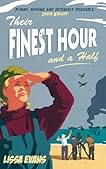
Their Finest Hour and a Half
This novel by Lissa Evans is just about perfect: expertly written in a style reminiscent of the literary fashions of the 1940s; full of wonderful characters that begin as stereotypes and take on flesh in an extraordinary way; expertly plotted and paced, with each development and surprise perfectly timed; unsentimental yet full of feeling; painstakingly researched; and on top of all that, it tells an absolutely fascinating story.That story is set in 1940-41 and tells of the making of a British propaganda film about an incident that allegedly took place during the Allied withdrawal from Dunkirk. Three plot lines intertwine. The first features a fading former leading man in B-grade British films of the 1930s who has not yet realized that his career has tanked; he’s a typical second-rate thespian, all vanity and superficiality and contempt for humanity at large. The second follows the career of a plain, shy, lonely seamstress who works in the wardrobe department at Madame Tussauds, the famous London wax museum, and has a tendency to attract German bombs. The third storyline centres on a young, pretty Welsh woman, the taken-for-granted mistress of a famous painter, who quits her copywriter’s job at a moribund advertising agency to go and work for the Ministry of Information as a scriptwriter on propaganda films. It is her determination to turn the Dunkirk incident into a film that tells the ‘truth’ about it – not the factual truth, which turns out to be somewhat disappointing, but an emotional truth – which results in the making of the film on which the plot of the book centres. That film, incidentally, is shot on location on a Norfolk beach and in a somewhat dingy studio in South London.
Each of these plot lines contains a love story, but the point of the story is not the progress of the love affair but the redemption or self-realization that results from it. Not all of the stories have happy endings.
Finally, the book contains two really excellent canine characters who are quite as well-rounded and memorable as the human ones. No kiddie business here; the dogs are dogs, not humans in disguise, but anyone who knows dogs well will be able to vouch for the veracity of the character-drawing.
All in all, an unqualified success. I tend to reserve my five-star ratings for world-changing or life-changing books, but this novel, while it certainly doesn’t fall into that category, probably deserves the extra star. It really is that good; my compliments to Ms. Evans.
14 September 2011
A Plain Tale from the Hills
I had recently finished (for perhaps the third time) Kipling’s Plain Tales from the Hills, a masterly collection of short stories originally published in the Lahore Civil and Military Gazette, a newspaper at which he worked as a young man. Rather presumptuously, I decided to try writing a story of the same kind – a kind of student piece in the manner of Kipling, in which Nuwara Eliya, the Ceylonese equivalent of Simla, would provide the frame, just as Simla did for the original Plain Tales. I don’t know how well I succeeded, but the magazine, Himal Southasian, accepted the piece for publication. You can read it here, and I hope you will, though if you can find and buy a copy of the magazine and read it there, that would be even better.
The central conceit, by the way, is stolen from another famous master of the short story, Jorge Luis Borges. Can you identify the story in which it appears?
Thank you, Mr. Hitchens
Letters to a Young ContrarianThough no longer young, I remain at heart a contrarian, someone who is driven to question conventional wisdom and popular attitudes. Indeed, I feel this is something of a duty – one in which I am far more lax than I have any excuse to be, and clearly far more lax than Mr. Hitchens is. Living as I do in a country that has fallen victim to creeping ethno-religious totalitarianism, my conscience was not simply pricked, but speared, when I read this:
The two worst things, as one can work out without leaving home, are racism and religion. When allied, these two approximate to what I imagine fascism must have felt like.
As we Sri Lankans know all too well, he is right. As we also know, fascism is hard to stand against. Amazingly, Hitchens offers a recommendation for living conscientiously with all kinds of oppression, one he calls living ‘as if’ – living as if one were a citizen of a free society, truly able to exercise all one’s rights and duties, so that one’s way of life becomes itself a form of protest.
In order to survive those years of stalemate and realpolitik... a number of important dissidents evolved a strategy for survival. In a phrase, they decided to live ‘as if’... Vaclav Havel, then working as a marginal playwright and poet in a society and state that truly merited the title of Absurd... proposed living ‘as if’ he were a citizen of a free society, ‘as if’ lying and cowardice were not mandatory patriotic duties, ‘as if’ his government had actually signed... the various treaties and agreements that enshrine universal human rights. He called this tactic 'The Power of the Powerless’ because, even when disagreement can be almost forbidden, a state that insists on actually compelling assent can be relatively easily made to look stupid.
I found this book put heart into me, reinforcing my belief that disagreement and argument are vital to the pursuit of happiness. I am no political activist, but I believe in certain values and know certain things to be true, and I try to live by these truths and values. The struggle is hard and often seems futile, especially when one’s friends and colleagues turn away to embrace the lie. At times like this, it is good to learn that the effort is not necessarily wasted. It is rarely one feels grateful to an author for writing a book. Thank you, Mr. Hitchens.
Subscribe to:
Comments (Atom)